PC Optimum is one of the most popular loyalty programs in Canada. Tens of millions of Canadians collect points at Loblaws, No Frills, Superstore, Zehrs, and a handful of other banners under the same corporate umbrella. The pitch is straightforward - shop, earn points, redeem for free groceries.
What the program does not advertise is that the shelf price of the same item can vary significantly depending on which banner you walk into. You earn the same points either way. You do not pay the same price.
We compared average observed shelf prices for 11 grocery staples across four PC Optimum grocery banners in Ontario over the first half of 2026. The total variance across the basket - the difference between always buying each item at the cheapest available PC banner versus the most expensive - was $10.82 on 11 items.
How We Ran the Analysis
We pulled price data for No Frills, Loblaws, Superstore, and Zehrs across Ontario from January through June 2026. All four included banners participate in the PC Optimum program.
The 11 items were selected based on consistent availability and sufficient observations across all four banners - a minimum of 20 price observations per item per banner was required. Items were anchored to specific package sizes throughout: butter at 454g, eggs at 12-count, milk at 4L, shredded cheese at 320g, cheddar at 400g, Greek yogurt at 750g, pasta at 900g, ground beef at 450g, and olive oil at 750ml. Proteins were filtered by price range. Total observations: 11,237.
Prices shown are average observed shelf prices over the 6-month period - a blend of regular and promotional weeks. Points earned through PC Optimum are not factored in. This analysis is about shelf price only.
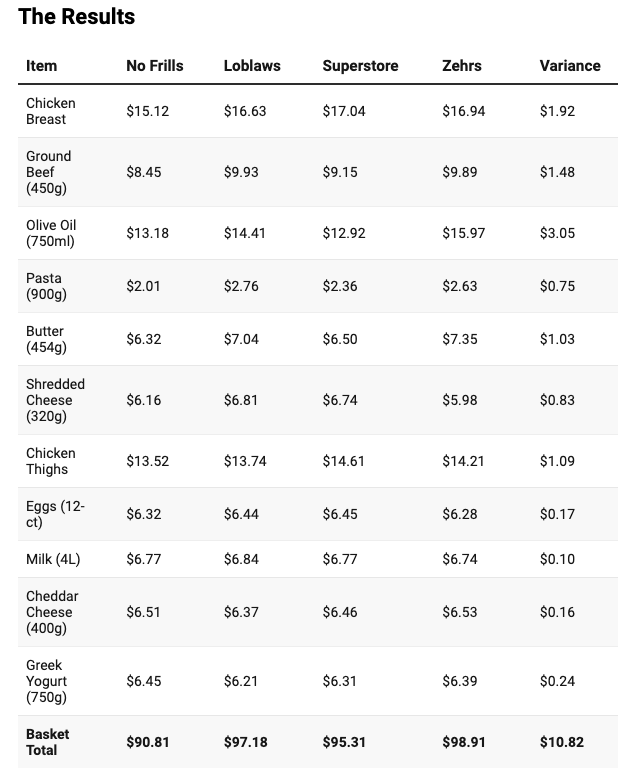
The cheapest banner for each item: No Frills leads on 7 of 11 items. Zehrs leads on 3. Loblaws leads on 2 - cheddar cheese and Greek yogurt, both by a small margin.
What the Variance Column Actually Means
The variance column is not No Frills versus Loblaws. It is the gap between the cheapest and most expensive PC banner available for each item regardless of which banner sits at either end.
Olive oil is the most striking example. Superstore at $12.92 versus Zehrs at $15.97 - a $3.05 gap on the same 750ml bottle in the same loyalty program. A shopper who habitually buys olive oil at Zehrs is paying $3.05 more than a shopper who buys it at Superstore. Both earn the same PC Optimum points. The points do not come close to bridging that gap on a regular basis.
The $10.82 total variance represents the real cost of being indifferent to which PC banner you shop at. It is not the cost of choosing Loblaws over a discount grocer. It is the cost of choosing the wrong banner within a single loyalty ecosystem on just 11 items.
The Staples Are Nearly Identical. The Proteins Are Not.
One pattern worth calling out: the tightest variances in the basket are on commodity staples. Eggs show only a $0.17 spread. Milk is $0.10. Cheddar cheese is $0.16. These items appear to be priced competitively across the program - possibly because they are benchmark items shoppers track closely.
The real divergence is in proteins and cooking oils. Chicken breast shows a $1.92 gap. Ground beef $1.48. Olive oil $3.05. These are the items where banner choice materially changes what you pay - and they are also the items where shoppers are least likely to comparison shop because the price is not as immediately memorable as a dozen eggs.
The Basket Total Question
Buying every item at the cheapest available PC banner produces a basket total of $89.92. Buying every item at the most expensive available PC banner produces $100.74. The $10.82 difference is the price of loyalty program indifference on 11 items. Scaled to a weekly shop across a broader basket, the annual implication is meaningful.
The program's value proposition is that points earned offset the cost of shopping. Based on typical PC Optimum earn rates, recouping $10.82 weekly through points alone would require redemption patterns most shoppers do not sustain. The shelf price gap tends to win.
Data collected by SAVR (savr.app), a Canadian grocery price comparison platform that tracks real-time shelf prices across major retailers. Prices are average observed shelf prices, Ontario only, January through June 2026. Minimum 20 observations per item per banner required for inclusion. Points values and redemption rates not factored into this analysis.